
A founder walks into a vendor meeting with a polished mockup, a Slack thread full of feature ideas, and a quiet assumption that the difficult part is writing the code. The screens look convincing, so the team expects a launch plan, a quote, and perhaps a promise that the app will be ready quickly.
In practice, פיתוח אפליקציה לעסק succeeds or fails long before the first production build. The difficult work is identifying the operational problem, defining the smallest useful product, choosing architecture that can survive real usage, and preparing the business to operate the system after launch. In Israel, that preparation also has to account for mobile-first behaviour, surge traffic, privacy obligations, legacy integration, and a market where software capability is central to business infrastructure.
Table of Contents
- Starting With Discovery Before Any Code
- Scoping the MVP So It Actually Ships
- Choosing Native or Cross-Platform for the Business
- Architecture, Data and Cloud Foundations
- QA, CI/CD, Security and Compliance in Delivery
- Realistic Timeline and Cost Ranges
- Post-Launch Operations and a 90-Day Plan
Starting With Discovery Before Any Code
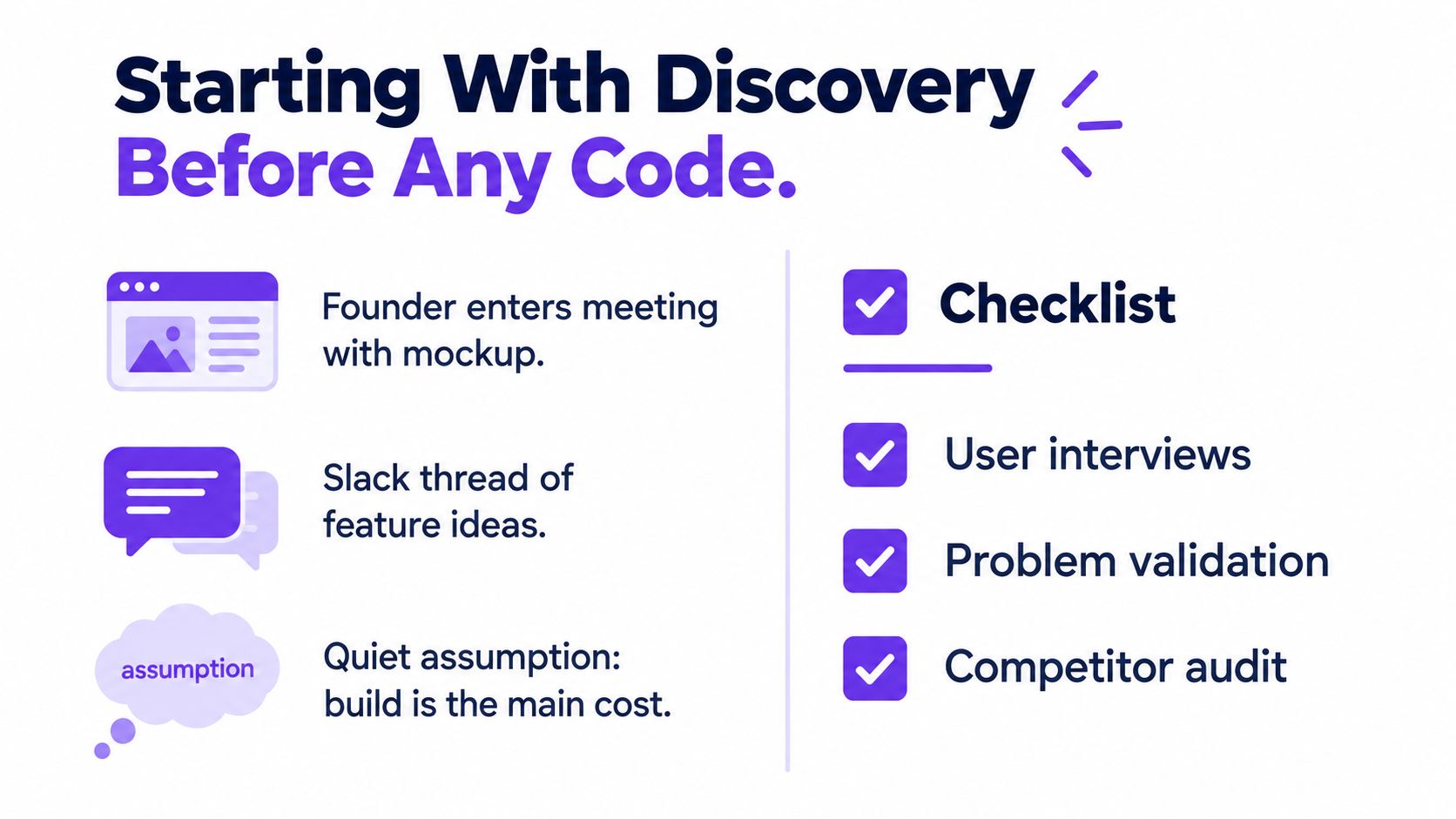
The founder presents the mockup. The operations lead explains that staff currently copy information between a CRM, spreadsheets, email, and a messaging app. The finance manager adds a requirement for approvals, while customer support asks for notifications and an audit trail. Everyone is discussing screens, but nobody has yet agreed which workflow the application must replace.
That is the point where discovery earns its keep. A serious discovery process establishes who uses the product, what job they need completed, what the business must learn, and which constraints will shape delivery. Israeli businesses are operating within a measurable digital divide. A government report cited by The Jerusalem Post's coverage of Israel's digital gap found that the share of Israeli businesses with high technological intensity is about three times smaller than the average among comparable developed countries, while ICT service exports represented 52.5% of Israel's total service exports in the benchmark analysis. The opportunity isn't to build another interface. It's to turn fragmented work into dependable software.
The outputs that prevent expensive assumptions
Discovery should leave the delivery team with concrete artefacts, not a collection of meeting notes:
- One-page problem statement: Describe the operational failure, the affected users, the current workaround, and the business consequence.
- Stakeholder map: Identify decision-makers, process owners, administrators, frontline users, customers, and people who will support the application.
- User research plan: Speak with at least eight interviewees across the primary personas, including people who use the current process and those who approve or maintain it.
- Current-state journeys: Map the sequence for each key persona, including handoffs, exceptions, delays, duplicate data entry, and failure recovery.
- Ranked business outcomes: Order the outcomes by importance, then define how the business will recognise progress after release.
The interviews should challenge the mockup. A warehouse worker may need barcode scanning and one-handed use, while an executive may only require a reliable approval summary. A customer may abandon a form because a mandatory field makes sense internally but not from their perspective. These findings should change scope before they become structural decisions.
Practical rule: Treat every assumption made in discovery as a future maintenance liability until a user, process owner, or system record validates it.
Skipping discovery is one of the most expensive mistakes in פיתוח אפליקציה לעסק because early assumptions become load-bearing walls in the codebase. Teams then protect a flawed workflow with more screens, more exceptions, and more integrations. For founders who want additional perspective on early product decisions, the startup AI blog from Thareja Technologies Inc. is a useful complementary resource, particularly when AI is being considered as part of a broader product workflow rather than added as a novelty.
Scoping the MVP So It Actually Ships
An MVP is not a short feature list. It's a controlled experiment that puts the smallest credible product in front of real users and measures whether it changes the chosen business outcome.
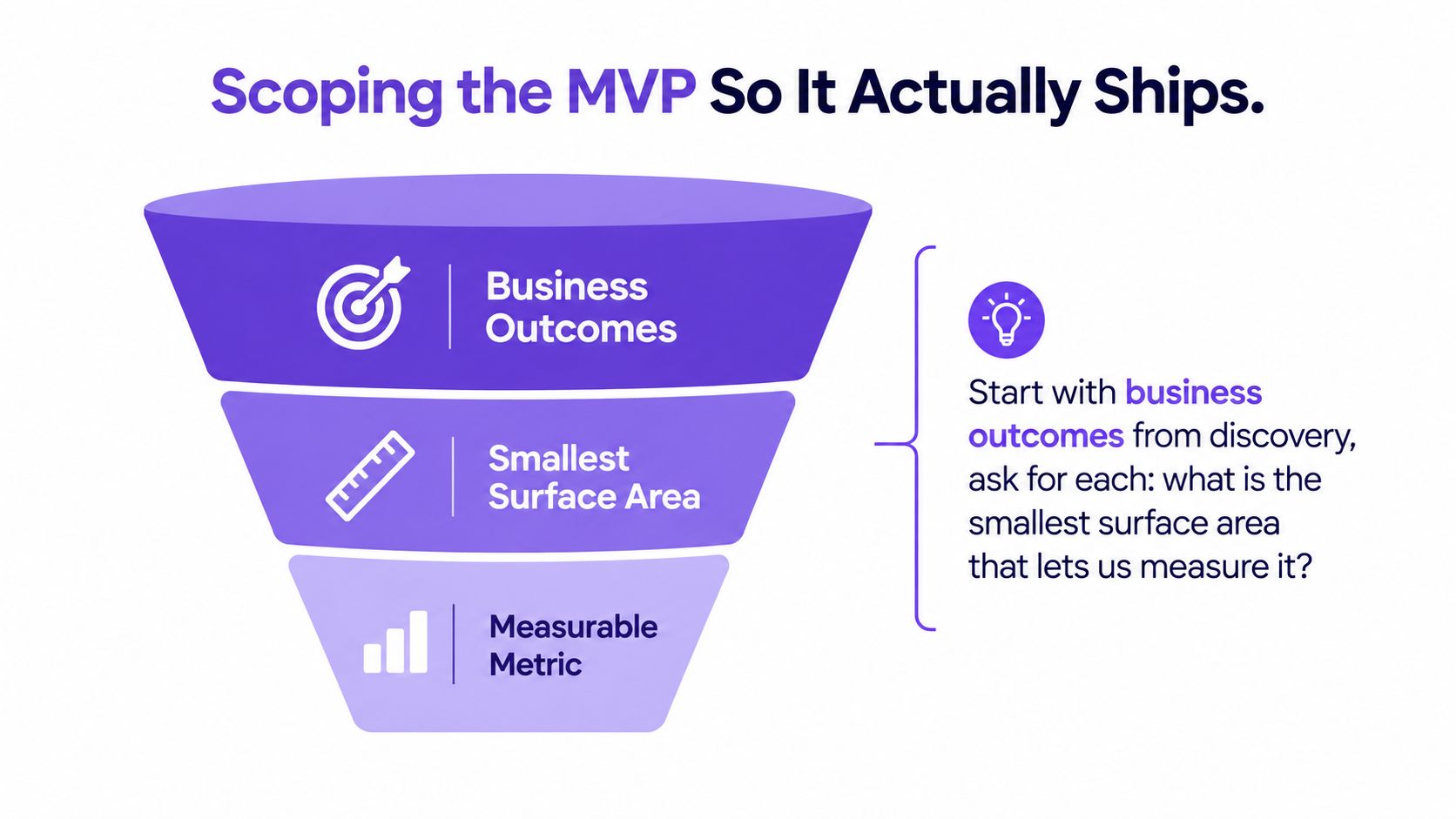
Start with the outcomes produced during discovery. For each outcome, ask: what's the smallest surface area that lets us measure this in production? If the outcome is faster approval, the first release might include request creation, reviewer assignment, a clear decision screen, notifications, and an audit record. It probably doesn't need a custom dashboard builder, complex delegation rules, or a configurable workflow editor.
Cut features by learning value
An opportunity solution tree helps the team trace proposed features back to outcomes. A ruthless MoSCoW pass can then classify the remaining work, but the labels only help when someone owns the cut list. Without ownership, an MVP expands into a small full product because every stakeholder describes their request as essential.
Use questions that expose decorative scope:
- Core job: What action must the user complete for the business to learn anything?
- Evidence: What behaviour would confirm that the workflow solves the problem?
- Risk: Which feature could invalidate the release if it's missing?
- Workaround: Can an operator handle the exception manually during the pilot?
- Cost of delay: Does this item improve the first learning cycle, or merely make the product look complete?
Acceptance criteria should describe behaviour, not screens. “The manager sees a dashboard” is weak. “A manager can approve a pending request, see the submitted evidence, and receive a recorded decision confirmation” gives design, engineering, QA, and stakeholders something testable.
Telemetry belongs inside the definition of done
A release isn't complete if the team can't tell whether users reached the intended outcome. The definition of done should include event naming, error capture, funnel instrumentation, permission checks, support documentation, and a way to distinguish a genuine product problem from a configuration issue.
A founder comparing approaches can also consult the SubmitMySaas MVP tutorial for founders for another practical perspective on reducing early scope. The important principle is simple: an MVP should be narrow enough to operate, observable enough to learn from, and flexible enough to change without rewriting the foundation.
Choosing Native or Cross-Platform for the Business
The native versus cross-platform decision should follow business constraints, not developer fashion. The right question isn't which framework is popular. It's whether the product needs platform-specific capabilities, how quickly both mobile platforms must reach users, and how long the organisation expects to evolve the application.
| Criterion | Native (iOS + Android) | Cross-Platform (Flutter / RN) | Hybrid / Web |
|---|---|---|---|
| Platform capabilities | Strongest access to OS and device features | Good for common capabilities, native modules may be needed | Limited or dependent on wrappers |
| Parallel delivery | Requires separate platform expertise | Shared UI and application logic can reduce duplication | Fast for simple experiences |
| Performance | Best control for demanding interactions | Usually suitable for business workflows, with tuning required | Suitable for content, forms, and light interaction |
| Maintenance | Two codebases and platform release processes | Shared codebase, but framework and native knowledge remain important | Simple for narrow scope, can become awkward as complexity grows |
| Best fit | Hardware-heavy, long-lived products | Two-platform MVPs and shared business flows | Content-led or form-led services with minimal offline behaviour |
When native earns its cost
Choose native iOS and Android development when the application depends heavily on platform-specific hardware, background processing, advanced camera functions, Bluetooth, biometrics, or deep operating-system integration. Native also makes sense when the product will sustain years of feature growth and the business can support specialists for both ecosystems.
The trade-off is duplicated implementation and release coordination. A feature can be conceptually shared while still requiring separate interface decisions, testing, accessibility work, and platform-specific failure handling.
Where cross-platform fits
Flutter or React Native can be a strong choice when a small team needs both platforms in parallel and the experience can be expressed through shared components. Cross-platform reduces duplicated UI work, but it doesn't remove native engineering. Payment flows, notifications, permissions, background tasks, camera features, and operating-system changes may require native modules or platform-specific fixes.
Long-term maintainability depends on the team's depth in the selected language and framework. A shared codebase that nobody understands isn't automatically cheaper.
Hybrid or web-based shells are sensible when the product is mostly content, forms, account access, or simple workflows, and offline behaviour is minimal. They become risky when users expect rich device interaction, fast transitions, or dependable operation under poor connectivity.
For a deeper side-by-side treatment, see Ryware's guide to native versus cross-platform mobile development. A practical decision lens is to map team size, performance needs, device reliance, and expected lifespan to the stack. Don't select a framework until those constraints are explicit.
Architecture, Data and Cloud Foundations
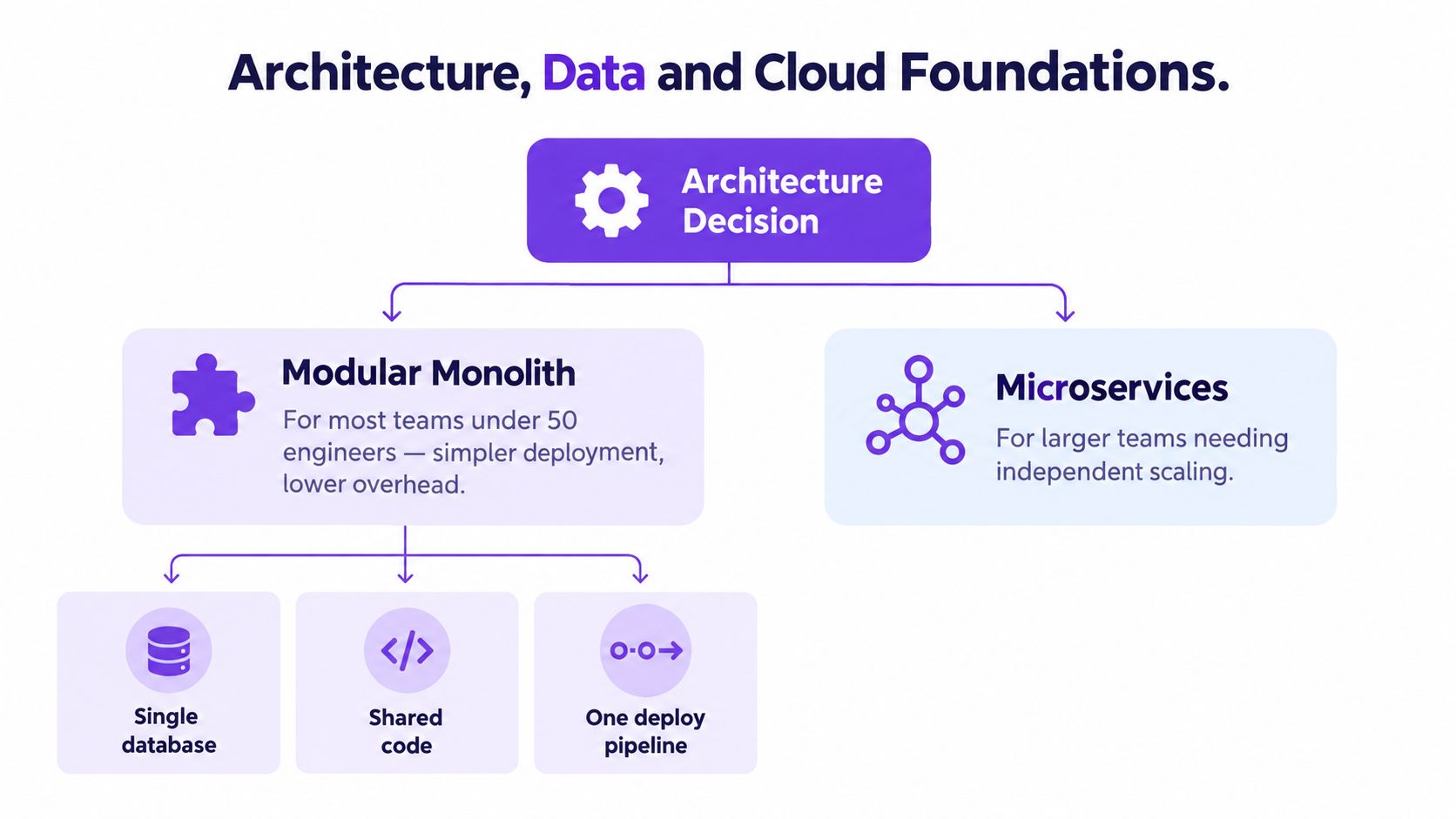
Architecture is a load-bearing business decision, not a backlog item to revisit after the MVP. For under 50 engineers, a modular monolith is the safer starting point: one deployable system with clear boundaries between identity, billing, catalogue, workflow, reporting, and administration. It keeps deployment and local development simpler while preserving a path to separate services if a module later needs independent scaling or ownership.
Microservices earn their overhead when larger teams need independent release cycles, stronger isolation, or distinct scaling characteristics. Starting with them too early often creates distributed tracing, deployment, versioning, and data-consistency work before the business has validated the product.
Match interfaces to the workflow
REST remains a practical default for mobile clients and B2B portals because its resources, caching behaviour, and operational tooling are familiar. GraphQL can suit portals with varied views over shared entities, particularly where clients need different fields without proliferating endpoints. gRPC is useful for internal service traffic where strongly typed contracts and efficient communication matter.
Whichever style the team chooses, contract testing should sit between mobile clients and the backend. A backend change that passes unit tests can still break an older app version if response fields, validation rules, or error semantics change unexpectedly.
Data storage should reflect the business rules:
- Relational databases: Use them for orders, approvals, payments, permissions, and any workflow where transactional integrity matters.
- Document stores: Consider them for flexible product catalogues or records whose shape changes frequently, but don't use flexibility as an excuse to avoid defining ownership and validation.
- Caching: Add it for repeated reads and carefully define invalidation behaviour.
- Event queues: Use asynchronous processing for notifications, imports, report generation, and other work that shouldn't block the user's request.
Cloud decisions include residency and operations
Choose cloud services according to latency, Israeli data residency needs, GDPR alignment, availability design, and the organisation's operating capability. Managed databases, queues, identity services, and monitoring can reduce undifferentiated operational work, but they still require ownership, access controls, backup testing, and cost monitoring.
Observability belongs in the architecture from day one. Structured logs should carry correlation identifiers, metrics should expose business and technical health, and distributed tracing should show where a request slows across the system. Place feature-flag evaluation deliberately, either close to the application with safe caching or behind a dependable service boundary. Flags that fail closed, expire automatically, and record exposure are safer than ad hoc configuration switches scattered through code.
QA, CI/CD, Security and Compliance in Delivery
Quality isn't a final gate before launch. It's the combined system of code review, automation, test environments, release controls, security checks, and production feedback that lets a team change software without guessing.
A dependable pipeline starts with trunk-based development or short-lived branches, pull request checks, automated unit and integration tests, and repeatable container builds. Mobile delivery adds device-farm coverage, signed release artefacts, TestFlight distribution for iOS, Play Console internal tracks for Android, and staged rollout controls. Backend changes should be released behind feature flags when the mobile client and server won't update at exactly the same time.
Build a testing pyramid around user risk
Unit tests should cover business rules and calculation logic. Contract tests should protect API compatibility. UI tests should focus on critical journeys such as sign-in, payment, approval, and recovery from interrupted sessions. Synthetic monitoring in production can exercise those journeys continuously from selected locations and alert the on-call engineer before support reports a failure.
Security needs the same continuity. Store secrets in a managed secret system, scan dependencies, run SAST checks, protect mobile binaries appropriately, and assess mobile controls against OWASP MASVS. Encrypt data at rest and in transit, restrict administrative access, and keep audit logs for sensitive actions.
Israel's privacy environment has changed materially. Amendment 13 to the Privacy Protection Law passed in August 2024 and took effect on 14 August 2025, introducing stronger enforcement, transparency duties, and governance obligations, as outlined in this overview of Israel's privacy reforms. The updated framework explicitly includes IP addresses, online identifiers, and geolocation as personal data, while sensitive categories include biometrics, genetic data, criminal records, sexual orientation, and financial details, according to this guide to Amendment 13.
Treat compliance as an engineering requirement
Israeli database security rules call for safeguards including encryption, access control, regular audits, vulnerability assessments, and severe-breach notification. Certain organisations, including public agencies, financial institutions, and companies maintaining five or more databases, may also need a Data Security Officer, as described in this summary of Israel's data security requirements.
For EU-facing products, map GDPR data subject rights into actual product operations, not just legal documents. Payment functionality may bring PCI DSS into scope, while enterprise buyers may expect SOC 2 evidence. A delivery lead should maintain a data inventory, retention rules, deletion workflows, consent records where relevant, and an incident runbook before production exposure.
Further implementation guidance is available in Ryware's mobile app development best practices, particularly for teams aligning release engineering with mobile reliability and security.
Realistic Timeline and Cost Ranges
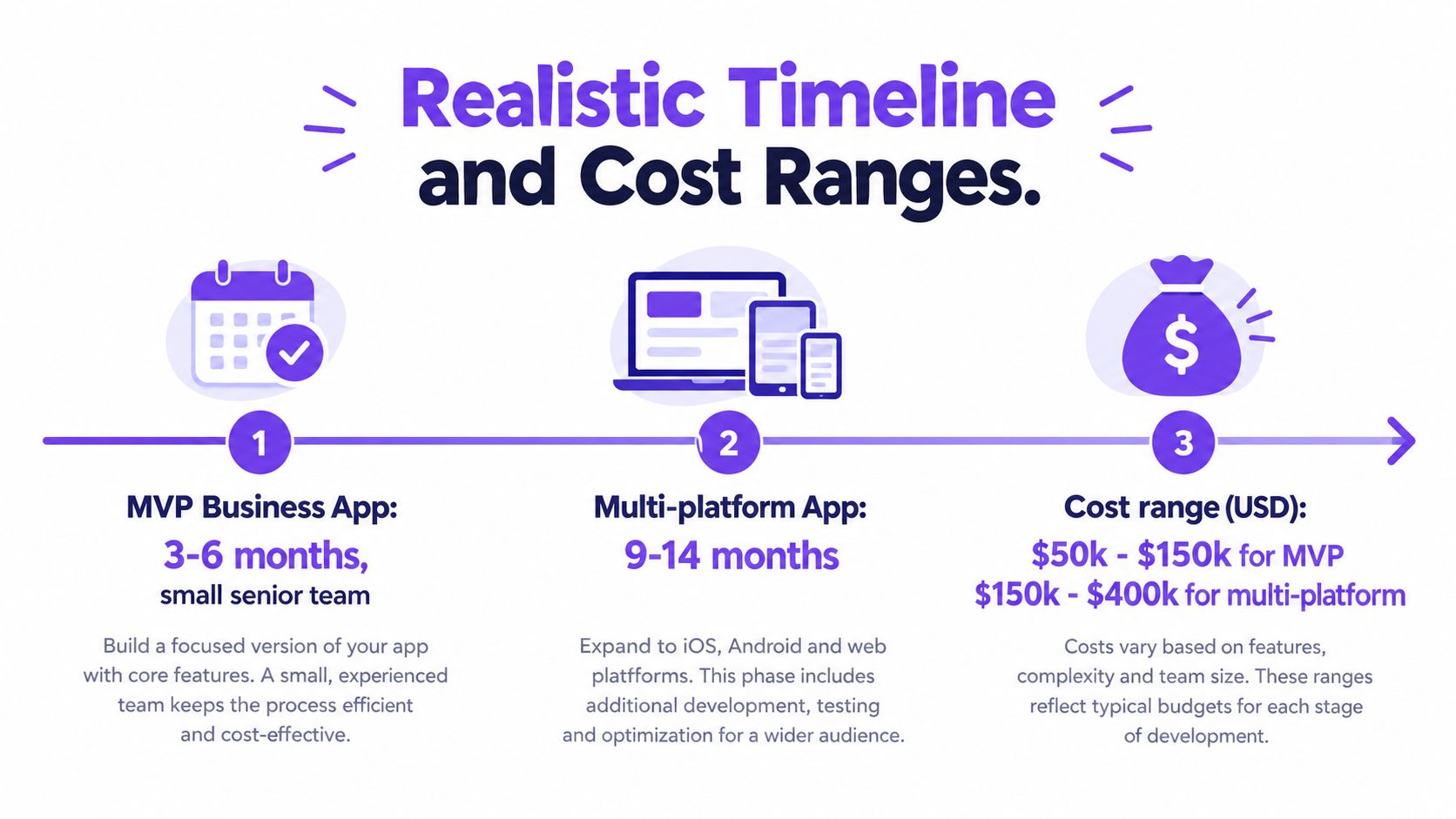
A credible estimate translates scope into delivery conditions. A small senior team might take roughly 3 to 6 months to deliver an MVP business app, while a multi-platform product with integrations, payments, and administration can take 9 to 14 months. Those ranges are scope benchmarks, not promises. They assume decisions are available, stakeholders respond, and the team isn't repeatedly rebuilding unclear requirements.
The budget follows the same logic. A visual planning benchmark places an MVP business app at $50,000 to $150,000, and a multi-platform product at $150,000 to $400,000, as represented in the supplied business app development cost timeline. Treat those figures as a scope conversation, not a market tariff.
What moves the estimate
The main cost drivers are team composition, location mix, design depth, integration count, backend complexity, compliance scope, and the post-launch runway. A simple workflow using an established identity provider is materially different from a regulated product integrating payments, legacy ERP data, role-based approvals, push notifications, reporting, and offline recovery.
Israeli senior engineers may cost more per hour than nearshore teams, while a full outsource model may reduce direct management load but increase dependency on vendor continuity and documentation quality. Churn creates hidden cost through lost context. Rework comes from unresolved requirements. Ambiguous ownership creates delays even when the engineering team is capable.
Fixed-bid contracts can work for a small, tightly specified MVP. Beyond that, they often encourage defensive change control, shallow discovery, or quality compromises. Time and materials with a capped burn, explicit milestones, and decision gates is usually a more honest model for evolving products.
A budget checklist
Reserve money for discovery, a 15 to 20% contingency, security and observability tooling, and 6 to 12 months of operations, including support, cloud costs, incident response, and incremental improvements. The Ryware software development cost calculator can help turn feature assumptions into a more structured planning discussion, but the delivery team still needs to validate every assumption behind the estimate.
Post-Launch Operations and a 90-Day Plan
Launch day is day zero of operations. The team needs a stabilisation window, an on-call rotation, a documented rollback path, and dashboards that show whether the application is functioning for users rather than merely returning successful server responses.
Monitor crash-free sessions, Android application-not-responding rates, p95 API latency, onboarding funnel drops, notification delivery, payment failures, queue depth, and infrastructure spend. These signals should be reviewed daily during stabilisation. If a release causes a serious problem, the team should be able to disable the affected feature or roll back without waiting for a new mobile binary.
Days 1 to 30
Focus on evidence and stability:
- Close instrumentation gaps: Verify that important user actions, errors, permissions, and business outcomes are recorded.
- Fix the top five reported defects: Rank them by user harm and operational impact, not by who complains most loudly.
- Check analytics quality: Remove duplicate events, inconsistent identifiers, and misleading funnel steps.
- Control backend costs: Review queries, storage, queue usage, and unexpected traffic patterns before they become recurring expenses.
Israeli usage patterns make this operational discipline especially important. A 2025 report cited in Israeli media recorded WhatsApp usage at 99%, YouTube at 97%, Facebook at 88%, Instagram at 81%, Telegram at 71%, TikTok at 57%, and LinkedIn at 36% of the Israeli population, according to ISOC-IL's social media and digital platforms data. Users are accustomed to frequent mobile interaction, so slow notifications, broken sessions, and unreliable updates damage trust quickly.
Days 31 to 60
Harden the product. Apply security patches, review access logs, refine push notification timing and grouping, and examine support tickets alongside session replays. Test interrupted journeys, weak connectivity, expired sessions, duplicate submissions, and recovery after a failed payment.
Mobile conditions can be volatile. Recent Israeli data reported that mobile internet browsing volume per subscriber rose 12%, and Telegram usage spiked by as much as 600% during alarms, while another dataset reported that 55% of Israelis pay almost always without cash, as summarised by Clutch's Israel app developer market data. The engineering implication is practical: design for surge traffic, alert-heavy communication, reliable push delivery, offline tolerance, payment failure handling, and strong observability rather than assuming steady office-hour usage.
Days 61 to 90
Move from stabilisation to managed product growth. Review A/B test results, retention cohorts, NPS, support themes, and operational incidents. Establish a quarterly OKR refresh through a product council that includes business ownership, engineering, operations, security, and customer support.
A useful handover checklist for the delivery lead includes:
- Runbooks: Document deployment, rollback, alert response, access changes, and data recovery.
- Release cadence: Set a predictable rhythm for biweekly features and weekly hotfixes, with staged rollouts and feature flags.
- Ownership: Name the person accountable for product decisions, technical operations, privacy, and incident communications.
- Roadmap governance: Link every proposed feature to an outcome, evidence, or required compliance change.
- Support loop: Feed tickets and observed user behaviour into prioritisation rather than relying on stakeholder intuition.
Feature flags need governance, not just a toggle in the admin panel. The team should record who enabled a flag, where it's active, what metric determines success, and when it expires. For teams managing staged functionality and roadmap exposure, a focused configuration platform such as NonaConfig can be relevant when feature and flag management needs a dedicated operational layer.
Israel's public-sector digital delivery reinforces this operating model. The 2024 ICT report recorded 526 projects, 873.5 million NIS in annual reported project cost, and 6,629 computing workers, with application work representing 40% of the project mix and security and compliance 4%, according to the Israel enterprise app development report. The lesson for a private business is not to copy government process. It's to treat the application as a governed operational programme with explicit data, cloud, security, support, and release responsibilities.
If your business is moving from fragmented workflows to a dependable web or mobile product, Ryware can support discovery, architecture, native or cross-platform development, API integration, QA automation, cloud delivery, and post-launch observability. Bring your current process map, mockups, or backlog to the conversation, and use them to define a product that can be operated reliably after launch, not just demonstrated in a meeting.